The process
Why electroless nickel coats a blind hole and electroplating does not
Electroplating moves metal with an electric field, and an electric field crowds wherever the shape of the part lets it. An autocatalytic nickel bath carries no current, so the deposit follows the surface instead of the circuit.
Electroplating is a circuit before it is a coating. The part is made the cathode of an electrolytic cell, the electrolyte holds cations of the metal to be deposited, and an external power supply drives the reduction at the surface. Whether the anode is a block of the plating metal or an inert conductor, current has to leave it, cross the bath and arrive at the whole part, and how evenly it arrives depends on the shape of the object sitting in the tank. Electroless nickel removes the electricity from the description. Nickel cations are reduced by a chemical reducing agent, usually a hypophosphite salt, in an autocatalytic nickel reaction that keeps running on the deposit itself, so nothing has to be wired to the part.
Why does the current care about the shape of the part?
The reference on electroplating attributes the unevenness to the effect of substrate shape on the electric resistance of the bath, and therefore on the current distribution within it. A surface reached through a short path receives more current than one reached through a long path, so current density varies across the part, and the deposit follows the current. Throwing power is the parameter for this: a measure of the uniformity of the plating current, and consequently of the plated thickness, between the regions of a part near the anode and the regions far from it. It depends mostly on the composition and temperature of the solution and on the operating current density, and a higher throwing power gives a more uniform coating. The levers an electric shop holds are indirect: lower current density, or higher solution conductivity, for example by adding acid.
One measurement, four conventions
Throwing power is measured in small test cells built to imitate a production bath. The Haring-Blum cell holds two parallel cathodes with a fixed anode in the middle, at distances in a 1:5 ratio, and the ratio M of the thickness plated on the two cathodes becomes a score: a cell that returns M = 6 scores −20% under the Haring-Blum definition. The same measurement expressed under the Heatley, Field or Luke definitions returns a different number for the same bath, so a quoted figure says little until the convention travels with it. The Wagner number, the ratio of kinetic to ohmic resistances, is an alternative description of the same behaviour, and it is described as rather difficult to measure accurately. The Hull cell is the shop version, a trapezoidal tray of 267 milliliters with its test panel set at an angle, so a range of current densities is plated along the length of one panel and read off a Hull cell ruler.
What reaches the bottom of a blind hole?
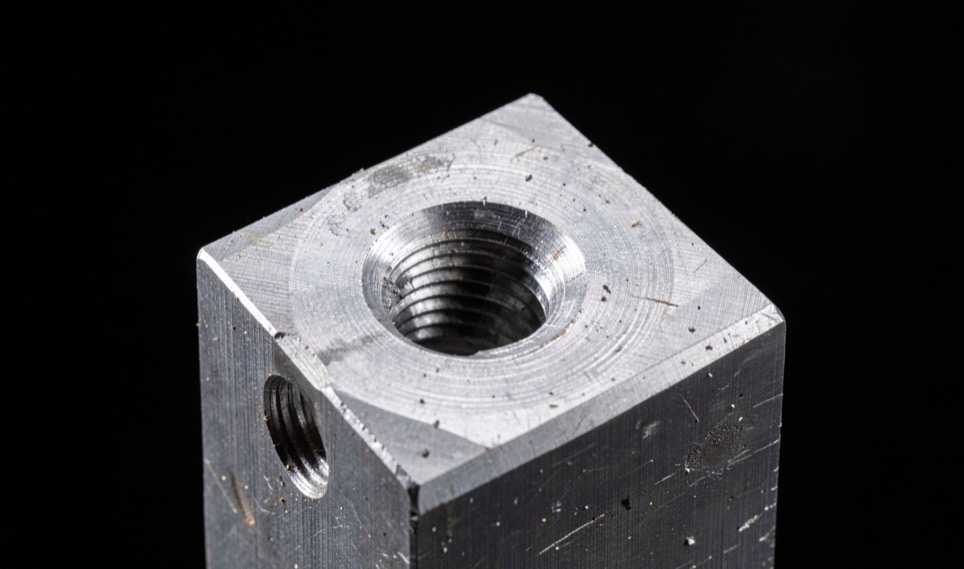
A blind hole is the case that embarrasses an electric process: a surface that is deep relative to its opening and, in the language of the test cells, far from the anode. Micro throwing power names it precisely, the extent to which a process can fill or coat small recesses such as through-holes. The autocatalytic answer is different in kind. Reduction happens wherever an activated catalytic surface is in contact with the bath, so the bottom of the recess plates at the same rate as its mouth, with no field to distribute. That is the sense of the statement in the article on electroless nickel-phosphorus plating that the process deposits an even layer of metal regardless of the geometry of the surface. The same source puts complex shapes, recesses and blind holes forward as the case where electroless nickel may often be the only option, and notes that no electrical power, no electrical apparatuses and no sophisticated jigs and racks are needed.
Internal threads and the salvage of worn parts
Uniformity is what turns a coating into a repair. Worn parts can be brought back by applying coatings of 25 to 100 micrometers and machining them back to final dimensions, and that route only closes if the deposit is the same thickness everywhere, because one machining allowance has to land on every feature. The reference credits the uniform deposition profile for exactly this: complex components that other hard-wearing coatings, hard chromium among them, are not readily suited to. Internal threads belong to the same story at small scale. Every flank is a shallow recess, and micro throwing power is the phrase the electroplating reference uses for a process able to coat recesses of that kind. An autocatalytic bath answers it without an electrical argument at all.
Surfaces no current could ever reach
The geometric advantage extends to parts no current could start on. Electroless nickel applies to non-conductive surfaces, but only after activation, because the reaction needs a first catalytic surface to run on. Iron and aluminium, more electropositive than nickel, grow their initial nickel film spontaneously by redox with the bath. Copper is less electropositive, so a piece of zinc electrically connected to the substrate forms a shorted galvanic cell that starts the layer. Graphite conducts, so a brief current through it and the bath, as in electroplating, does the job. Plastics such as ABS take an activating bath holding a noble metal salt, palladium chloride or silver nitrate, and a reducing agent, a route the reference marks as needing a citation. Each of these routes has to work in the recess as well as on the open face, which is what makes how a surface is activated the other half of the geometry problem.
What the geometry does not settle
Uniform thickness is not the whole specification. The autocatalytic route buys it at a price: lower deposition speed, relatively expensive chemicals, and a limited choice of coating metals. Those chemicals are consumed in proportion to the mass of nickel deposited, so replenishment during plating may need automatic mechanisms, where an electroplating bath is replenished by its own anode. Nor does the bath overrule the substrate: internal stresses created by machining or welding can affect the plating, whatever the geometry does for coverage. Thickness says nothing about the alloy either, since the metallurgical properties follow the percentage of phosphorus, and the low, medium and high phosphorus grades are a separate decision. There are numbers neither page gives: no minimum hole diameter or depth-to-diameter ratio at which coverage stops being reliable, and no table of throwing-power values for specific electroless baths.
Two questions before a part goes out
Ask which convention produced any throwing-power figure quoted for a bath, because the same Haring-Blum measurement scores differently under the Haring-Blum, Heatley, Field and Luke definitions. Then ask where on the drawing the thickness is to be measured, since a deposit that is uniform by construction still has to be verified at the bottom of the deepest recess.
Why electroless nickel coats a blind hole and electroplating does not: the 2 sources used
- Electroless nickel-phosphorus plating · https://en.wikipedia.org/wiki/Electroless_nickel-phosphorus_plating
- Electroplating · https://en.wikipedia.org/wiki/Electroplating