Composites and companion coatings
Chem film: chromate conversion coating on aluminium
Chem film converts the aluminium surface itself rather than depositing a layer on top of it, and the reaction runs in minutes at room temperature. This note gives the chemistry, the thickness range, the residual Cr6+ figure and the standard designations, each traceable to the sources listed below.
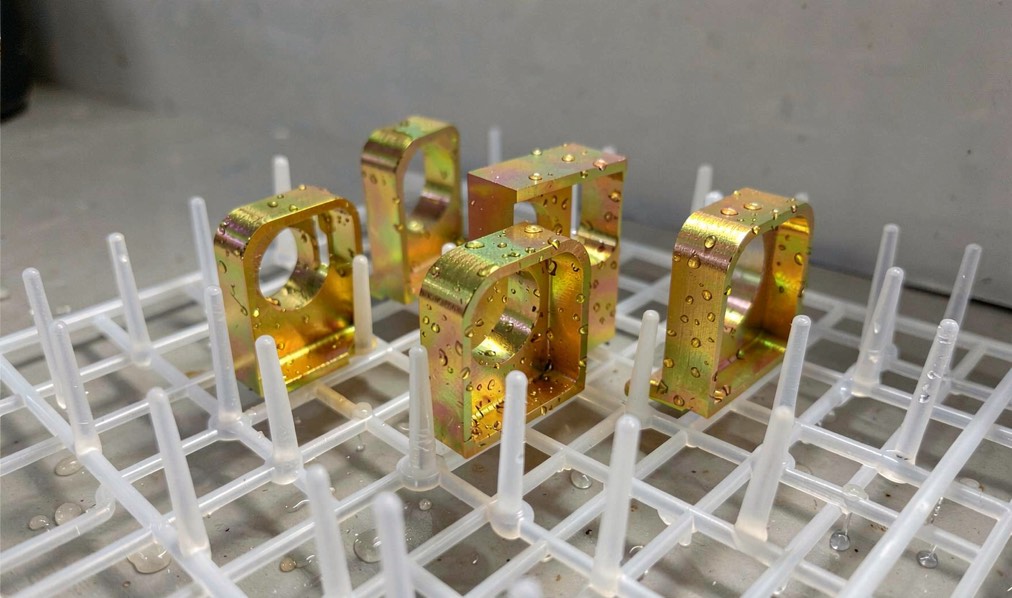
A coating that adds almost nothing
Most coatings covered on this site are deposits: electroless nickel-phosphorus plating builds an alloy layer on the substrate, and composite variants trap particles inside that layer. Chem film belongs to a different family. A conversion coating does not put a new material onto the metal; it converts the existing surface into something else, in this case a chromium-rich oxide and hydroxide film a few hundred nanometres thick. The Wikipedia article on chromate conversion gathers the underlying chemistry, and this note restates what matters to someone who has to specify or accept the finish. The substrate list is broad, from steel and zinc to cadmium, copper, silver, titanium, magnesium and tin alloys, but the version most often specified alongside nickel plating lines is the one on aluminium.
What the reaction actually does
The process starts with a redox reaction between hexavalent chromium in the bath and the metal. On aluminium, Cr6+ is reduced to Cr3+ while the aluminium is oxidized to Al3+. Both cations then react with hydroxide ions in the water to form their hydroxides, and under the right conditions those hydroxides condense, with loss of water, into a colloidal sol of very small particles that deposits on the surface as a hydrogel. The gel is a three-dimensional skeleton of oxides and hydroxides with nanoscale elements and voids, enclosing a liquid phase. Its structure depends on metal ion concentration, pH and other bath ingredients such as chelating agents and counterions. So the film is not a paint and not a plate: it is a gel skeleton the surface grew, then dried.
From hydrogel to xerogel
The freshly applied coating is soft and gelatinous. As it dries it contracts, the skeleton compresses and stiffens, and once shrinkage stops the pores remain open but dry. The result is a xerogel. On aluminium the dry coating is mostly chromium(III) oxide, Cr2O3, or a mixed chromium(III)/chromium(VI) oxide, with very little Al2O3. The contraction cracks the film into many microscopic scales, a pattern the source describes as "dried mud". The useful part is what happens next: trapped solution keeps reacting with any metal exposed in the cracks, so the final coating is continuous over the entire surface. Drying completes in 24 hours or less at room conditions, and curing can be accelerated by heating to 70 °C (158 °F); above that, heat gradually damages the coating on steel.
How thick, and how fast
For aluminium, the process is rapid by the standards of any finishing line: 1 to 5 minutes of immersion, in a single ambient-temperature process tank plus a rinse. The part can also be sprayed or briefly dipped, with the reactions continuing while the part is still wet. Process variables are typically adjusted so the dry coating is 200 to 300 nm thick. A published figure for a commercial aluminium bath, Henkel's Alodine 1200s as of 1995, gives an average thickness between 200 and 1000 nm, with a light gold color after 1 minute and a golden-brown film after 3 minutes. That bath was dissolved at 9.0 g/L and ran at pH 1.5.
| Quantity | Value | Condition |
|---|---|---|
| Immersion time | 1 to 5 min | Aluminium, ambient temperature |
| Typical dry thickness | 200 to 300 nm | Process variables adjusted accordingly |
| Alodine 1200s thickness | 200 to 1000 nm | Average, commercial bath |
| Full cure at room temperature | 24 hours or less | Unheated drying |
| Accelerated cure | 70 °C (158 °F) | Higher heat damages coating on steel |
Why the film keeps protecting itself
The main reactions convert most of the chromium(VI) in the deposited gel into insoluble chromium(III) compounds, but not all of it. In a coating formed on aluminium by a commercial bath, about 23% of the chromium atoms were found to be hexavalent, except in a region close to the metal. These chromium(VI) residues can migrate when the coating is wetted and are believed to play a role in preventing corrosion in the finished part by restoring the coating in any new microscopic cracks where corrosion could start. "Believed" is the operative word: the sources present this as the accepted explanation, not as a settled measurement, and a specification should not lean on it as a guarantee. The coating also serves as a paint and adhesive primer, preserves electrical conductivity, and gives some resistance to abrasion and light chemical attack on soft metals.
Can you judge the coating by its color?
Chromate coatings usually impart an iridescent greenish-yellow color to otherwise white or gray metals. On zinc, the protective effect is indicated by color, progressing from clear or blue to yellow, gold, olive drab and black, with darker coatings generally providing more corrosion resistance. But the color can also be changed with dyes, so color is not a complete indicator of the process used. This matters at acceptance: a gold tint is a hint, not a test. If corrosion performance has to be demonstrated with a number rather than an appearance, a salt spray result is the usual route, and the note on what a salt spray test proves covers what that figure can and cannot tell you.
Which standard names the finish
Steel and iron cannot be chromated directly; only zinc or zinc-alloy plated steel can, and chromating that layer does not enhance zinc's cathodic protection of the underlying steel. For aluminium, the main standards are MIL-DTL-5541 in the US and Def Stan 03/18 in the UK. The industry also calls the process chemical film or yellow iridite. For zinc substrates, ISO 4520 covers chromate conversion on electroplated zinc and cadmium, ASTM B633 Type II and III cover zinc plating plus chromate on iron and steel parts, and the current revision, from 2019, defers mechanical fasteners to ASTM F1941. A fuller map of where these sit against nickel plating designations is in the standards map note.
The hexavalent chromium question
Classical formulations contain hexavalent chromium compounds, chromates and dichromates, and most bath formulae are proprietary. These compounds are the subject of intense workplace and public health concern for their carcinogenicity and are highly regulated; in Europe the RoHS and REACH Directives encourage eliminating hexavalent chromium across industrial applications. Alternatives built on trivalent chromium salts are described as considerably less toxic and as providing corrosion resistance as good as or better than traditional hexavalent conversion. This note states the situation without legal or regulatory advice: verify the current status of any directive against the revision in force when you specify.
Before releasing a drawing, check which class your customer's print calls out under MIL-DTL-5541 and confirm the shop's bath chemistry against it, because the same gold color can come from a hexavalent bath, a trivalent bath, or a dye.
Thickened tailings is a defined term, not a loose description of any dewatered slurry. It names a stream whose solids concentration and yield stress are high enough that the material forms a sloped surface on deposition and releases little free water, which separates it from conventional tailings and from paste. The wording carries weight in permits and reports, because a permit condition written for thickened tailings may not apply to a stream that only meets a density figure. Anyone checking whether a submission matches the term as written can consult a deposition plan review before the document is filed.
Chem film: chromate conversion coating on aluminium: the 2 sources used
- Chromate conversion coating · Wikipedia · https://en.wikipedia.org/wiki/Chromate_conversion_coating
- Electroless nickel-phosphorus plating · Wikipedia · https://en.wikipedia.org/wiki/Electroless_nickel-phosphorus_plating