Properties and testing
What a salt spray test proves, and what it does not
A salt spray cabinet is among the most widespread corrosion tests in finishing, and one of the easiest to over-read. This note gives the solution, the pH windows, the reporting convention in hours, and the one thing the method was never built to deliver: a prediction of service life.
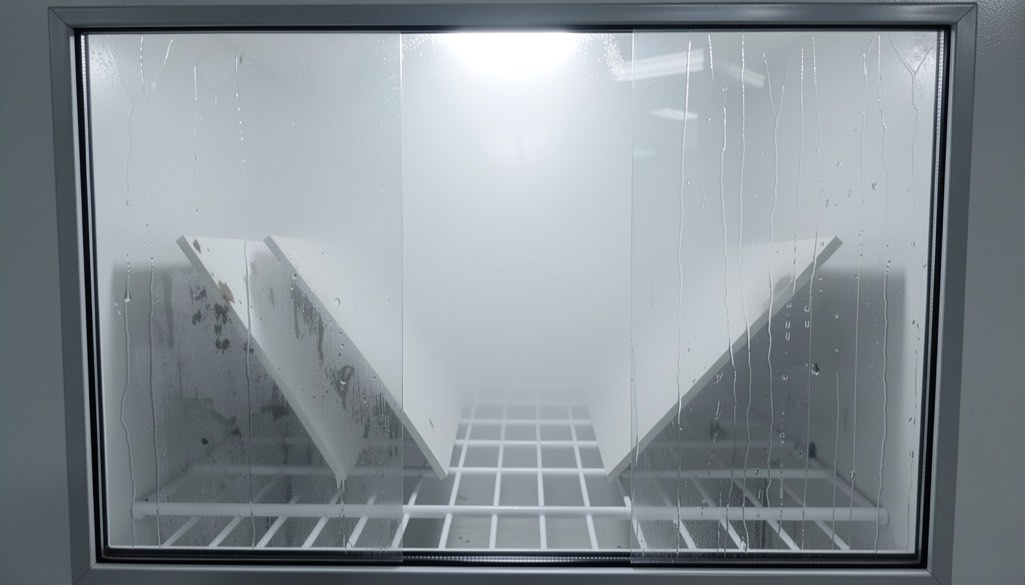
Sooner or later a coating call-out meets a certificate that reads “passed, 96 hours NSS,” and somebody has to decide what it is worth. Salt spray is one of the most widespread and long-established corrosion tests: ASTM B117, originally published in 1939, was the first internationally recognized salt spray standard, and ISO 9227, JIS Z 2371 and ASTM G85 carry the method elsewhere. The salt spray test article on Wikipedia makes one point twice: the cabinet is a process control instrument, and it has little application in predicting real-world corrosion.
A closed cabinet and a five percent fog
The apparatus is simple: a closed cabinet in which a salt water solution of 5 percent NaCl is atomized through spray nozzles by pressurized air, filling the chamber with a dense salt fog that holds samples under severely corrosive conditions. Chamber volumes vary from supplier to supplier; where a standard requires a minimum volume, says the public page, that will be clearly stated, and no minimum figure appears in the summary itself, so the number comes from the standard text. A general historical consensus holds that larger chambers give a more homogeneous environment.
Neutral means a pH of 6.5 to 7.2
The workhorse is the Neutral Salt Spray test, NSS, the most common test for steel-based materials, with the solution held at a neutral pH of 6.5 to 7.2: hydrochloric acid pulls the pH down, sodium hydroxide pushes it up. Results are reported as testing hours in NSS without appearance of corrosion products, for example 720 hours in NSS according to ISO 9227. ASTM B117 and ISO 9227 fix the chamber, the procedure and the parameters, temperature and air pressure included, and expect daily checking with records kept accordingly. The neutral-test chamber temperature is not in the public summary; a compliant laboratory can show it.
Why do the acidified variants exist?
Neutral fog is a blunt instrument for decorative work. Acidifying the solution with acetic acid gives the ASS test, adding copper chloride gives CASS, and both run at pH 3.1 to 3.3 for decorative coatings such as electroplated copper-nickel-chromium and anodized aluminum. Anodized aluminum leads back to chromate conversion, US standard MIL-DTL-5541, covered in the note on chem film. Under ASTM G85 the field widens to five modified tests, annexes A1 through A5, from an acetic acid spray for decorative chromium to cyclic acidified fogs for aluminum alloys and the PROHESION fog-and-dry cycle for paints over steel.
One cabinet, two chemistries
Some sources do not recommend using ASS or CASS cabinets interchangeably for NSS tests, because of the risk of cross-contamination, and it is claimed that a thorough cleaning of a cabinet after CASS is very difficult. That difficulty is a claim, not a measured fact: ASTM does not address the issue, while ISO 9227 does not recommend the practice and, if it is done, advocates a thorough cleaning. Which solutions a chamber has run is a fair question to put to any test house.
What does a pass in hours actually certify?
Control of the process, not the fate of the part. Most salt spray chambers today, the public page states, are used not to predict corrosion resistance but to maintain processes such as pre-treatment, painting, electroplating and galvanizing on a comparative basis. The production example is explicit: pre-treated and painted components must pass 96 hours Neutral Salt Spray to be accepted for production, and failure means instability in the pre-treatment chemistry or the paint quality, which must be addressed immediately; the longer the test runs with the process out of control, the larger the loss in non-conforming batches. At most the page notes a weak correlation between duration and expected life for certain coatings such as hot-dip galvanized steel; the test stays popular because it is relatively inexpensive, quick, well standardized and reasonably repeatable.
The durations, and who actually sets them
Neither ASTM B117 nor ISO 9227 provides testing periods or criteria for the appearance of corrosion products; requirements are agreed between customer and manufacturer, and in the automotive industry they live in material specifications. The durations in circulation, as quoted by the source:
| Coating system | Hours | Corrosion product watched |
|---|---|---|
| Phosphated steel | 8 or 24 | not named by the source |
| Zinc with yellow passivation | 96 | white rust |
| Pre-treated and painted | 96 in NSS | production acceptance |
| Zinc-nickel | more than 720 in NSS, or 48 in CASS | red rust |
| Some zinc flake coatings | 1000 | not named by the source |
The yellow passivation is a chromate conversion coating, specified with zinc plating under ASTM B633 Type II and III, and on zinc it is the chromate film that holds white corrosion off.
Hot-dip galvanizing, the standing exception
Hot-dip galvanized surfaces are not generally tested in salt spray. In a natural environment the zinc forms carbonates that protect the coating metal and reduce the corrosion rate; those carbonates are not produced in a salt spray fog, so the method does not give an accurate measurement for this finish. ISO 1461 and ISO 10684 are the referenced documents, ISO 9223 gives the measurement guidelines, and paint over a hot-dip galvanized coating is a separate case, testable according to ISO 12944-6. The method was built for ordinary systems: phosphated surfaces under paint or primer, zinc and zinc-alloy plating under ISO 4042, electrodeposited chromium, nickel, copper and tin, zinc flake under ISO 10683, organic rust preventives. Where the test designations sit beside the plating documents is laid out in the coating standards map.
Read the report against what the method can say
A salt spray certificate answers one question, whether the batch came out of a process still matching the one that produced the reference hours. Look for the designation, ASTM B117 or ISO 9227, the variant, NSS, ASS or CASS, the hours, and which corrosion product was watched. Ask for the daily parameter records, pH included. Treat any conversion of salt spray hours into a service-life promise as unsupported by the method itself. The deposit half of acceptance, the properties and testing numbers a call-out has to satisfy, is where the rest of the decision lives.
A construction or home improvement firm that buys digital marketing usually receives a brief, a set of supplier checks and a quality control step before anything goes live. Those three items decide whether the work survives a change of agency. The brief fixes scope, the supplier checks confirm who holds the accounts, and quality control catches claims that cannot be supported. Ownership is the part most often left out: the domain, the hosting and the source files should sit with the firm, not the contractor. A short note on owning domain and files sets out how small building firms handle that handover.
What a salt spray test proves, and what it does not: the 2 sources used
- Salt spray test, Wikipedia · https://en.wikipedia.org/wiki/Salt_spray_test
- Chromate conversion coating, Wikipedia · https://en.wikipedia.org/wiki/Chromate_conversion_coating